Lloyd Neck’s Cadastral Uncanny: How the Marshall Field III Estate’s Boundary Geometries Produced a Landscape of Deliberate Inaccessibility as Aesthetic Program
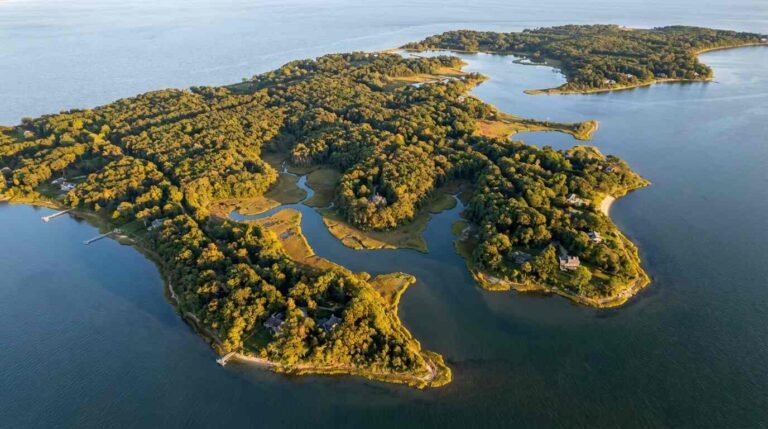
There are places on the North Shore that you cannot quite find from the land. You drive out toward them, following roads that narrow and then stop, and at some point you realize that the absence of road is itself the point — that what you are experiencing is not a gap in the infrastructure but a decision encoded into the landscape. Lloyd Neck is the most complete example of this that I know of anywhere on Long Island. The peninsula juts into Cold Spring Harbor at an angle that would make it one of the most accessible waterfront communities on the North Shore if the road network had been allowed to develop naturally. It wasn’t. And the reason it wasn’t is a story about how Gold Coast wealth used land geometry as aesthetic program.
Marshall Field III — grandson of the department store founder, one of the significant twentieth-century figures in American liberal philanthropy — assembled a large estate on Lloyd Neck through a series of purchases in the 1920s and 1930s. The Suffolk County Clerk’s deed records document the consolidations: parcels acquired, boundaries redrawn, the slow accumulation of control over a peninsula that had, in earlier periods, been more permeable. The result was a property whose defining characteristic was not what it contained but what it excluded — not its architecture, which was modest by Gold Coast standards, but its geometry, which was not modest at all.
The Boundary as Aesthetic Gesture
The geographer Denis Cosgrove, in Social Formation and Symbolic Landscape (1984), argued that landscape is never simply what you see. It is a way of seeing — a culturally specific practice of organizing visual experience that encodes social relations, power hierarchies, and ideological assumptions into the arrangement of the visible world. The English landscape park, Cosgrove’s primary case study, was not a natural environment that happened to look beautiful. It was an ideological production: land reorganized to produce the appearance of natural order while concealing the labor and power relations that maintained it.
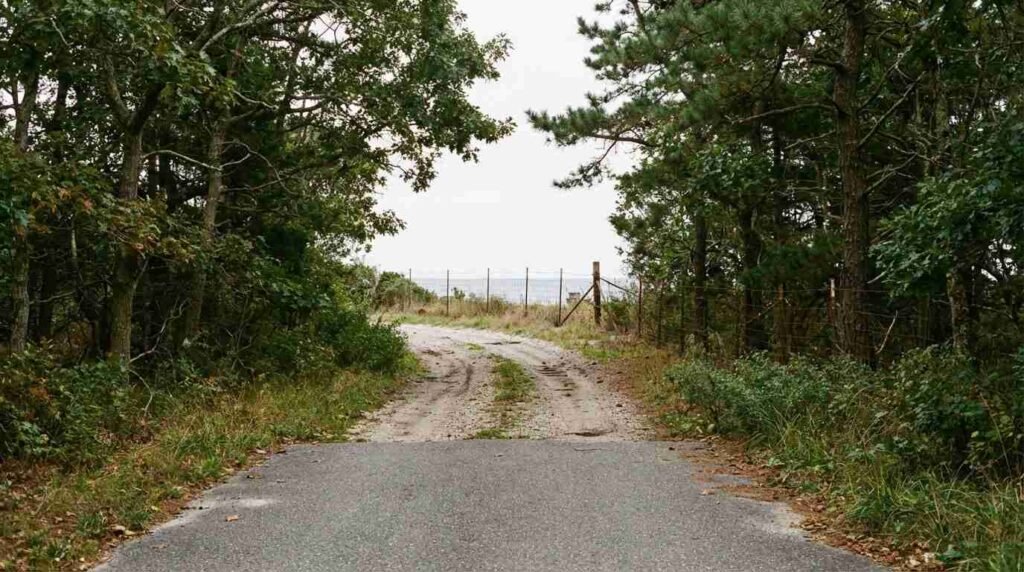
The Lloyd Neck estate’s boundary geometry operates according to similar logic. The peninsula’s road network — or rather, the deliberate suppression of what might have been a road network — is the primary aesthetic gesture. Where other Gold Coast estates announced themselves through entrance gates, allées, formal approaches designed to manage the transition from public road to private magnificence, the Field estate made its primary statement through absence: the roads simply did not continue. The landscape performed exclusion not through dramatic architectural declaration but through the quiet engineering of inaccessibility.
W.J.T. Mitchell’s essay “Imperial Landscape,” collected in Landscape and Power (1994), extends Cosgrove’s analysis to the relationship between landscape aesthetics and colonial power, arguing that the capacity to organize a landscape — to determine what is visible from where, to control the viewer’s position — is itself a form of dominance. The Lloyd Neck estate is a domestic version of this logic, smaller in scale but identical in structure: the landscape is organized to produce specific viewing experiences and to deny others.
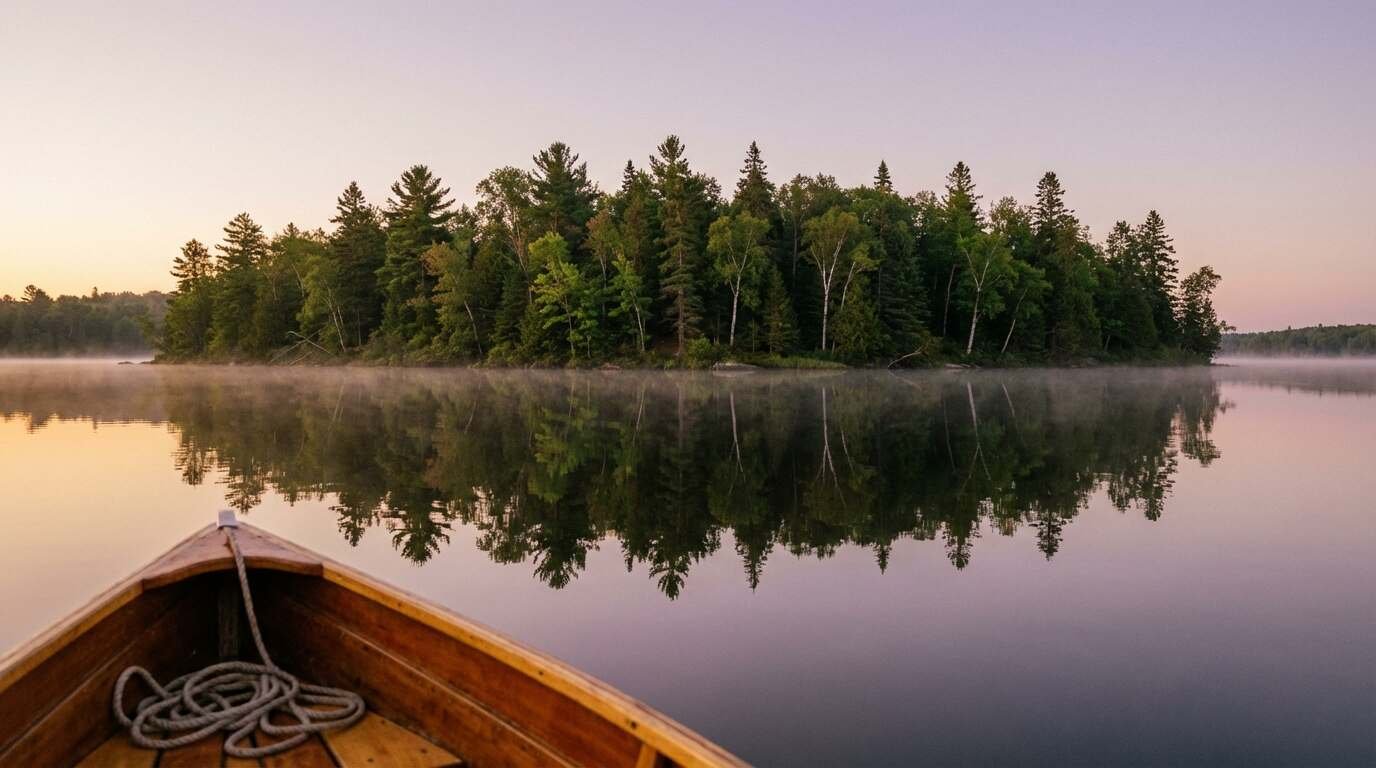
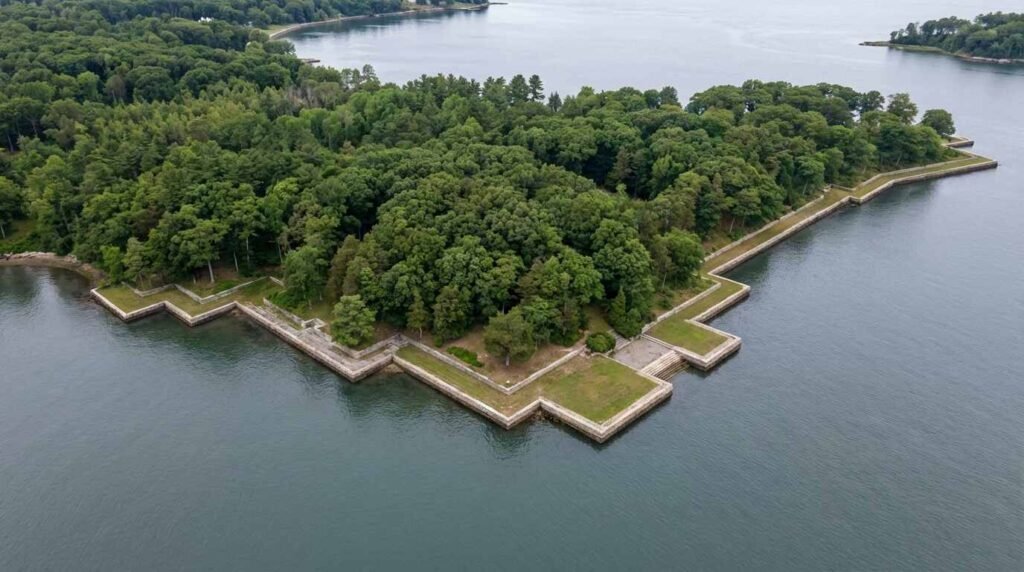
The view that the estate’s geometry was designed to produce is, precisely, not available from the land. The intended picture plane is the water. From Cold Spring Harbor — from a boat, or from the opposite shore — the Lloyd Neck peninsula reads as a composed landscape: a wooded headland, the geometry of its shoreline implying an order that the land-based visitor cannot access or confirm. The Sound is the viewer. The estate geometries are the picture. The exclusion of the land-based visitor is what makes the picture possible.
Robert Moses and the Access Question
Robert Caro’s The Power Broker (1974) is not primarily about Lloyd Neck — it is about Robert Moses, the man who determined more than anyone else what Long Island would look like and who would be able to use it. But Moses’s presence shadows the Lloyd Neck story, because the parkway access battles of the 1920s and 1930s that Caro documents so precisely are exactly the context in which the Field estate’s land consolidations occurred.
Moses’s parkways were designed, famously, to control access — the overpasses built too low for buses, the beaches engineered for automobiles and therefore for the class of people who owned automobiles. The North Shore’s resistance to Moses’s incursions — and Lloyd Neck was part of the North Shore resistance, the Gold Coast’s successful effort to keep public infrastructure from penetrating its most exclusive enclaves — meant that the peninsula’s road network remained suppressed. Moses wanted the parkways to democratize access to Long Island’s coastline. The Gold Coast wanted the opposite. Lloyd Neck is what the Gold Coast’s victory looks like.
The Target Rock National Wildlife Refuge, which occupies the northern tip of Lloyd Neck as an adjacent parcel, was acquired by the federal government precisely because private ownership had so thoroughly controlled the surrounding land that public access to the water was otherwise impossible. The wildlife refuge is, in this sense, a monument to the Field estate’s success: a carve-out of public accessibility at the very edge of a peninsula that had been privately organized against it.
The Lloyd Harbor Study Center and the Estate’s Afterlife
The Lloyd Harbor Study Center now occupies portions of the former Field estate. Environmental education, field research, community programming — the uses are entirely legitimate and the organization does genuine work. But the spatial organization of the peninsula has not changed. The roads are still absent. The shoreline is still controlled. The landscape that the Field estate produced through its boundary geometries is still, in its essential structure, the landscape that exists today.
This is one of the things I find most interesting about Gold Coast properties when I am working with buyers or heirs: the landscape decisions made in the 1920s and 1930s remain legible and consequential a century later. The geometry of exclusion, once established, does not easily dissolve. The deed boundaries, the road suppressions, the shoreline controls — these outlast the families that created them, the ideologies that motivated them, the economic conditions that made them possible. They become simply the landscape, naturalized, stripped of their intentionality, experienced as geography rather than decision.
The properties adjacent to the former Field estate on Lloyd Neck carry this history in their surveys. The SPLIA property survey files for the peninsula document the layering of ownership and use that produced the current landscape. Buyers interested in waterfront property in this area should understand that what they are acquiring is not just a parcel but a position within a spatial argument that was made a hundred years ago by people with very specific interests in controlling who could see what from where.
Reading the Landscape From the Water
I keep coming back to the view from the water. It is the only vantage from which the Lloyd Neck estate geometries fully resolve into something you could call a composition. From the boat — from Cold Spring Harbor or Long Island Sound — the peninsula presents as a coherent landscape: wooded, calm, the shoreline articulating a geometry that reads as natural but is in fact highly managed. It is beautiful in the way that all deliberate landscapes are beautiful when the deliberateness becomes invisible.
Cosgrove argued that landscape aesthetics in the Western tradition are fundamentally connected to a way of seeing associated with property ownership — the prospect view, the panorama, the capacity to survey a territory from a position of command. The Lloyd Neck estate’s insistence on the water as picture plane is a precise inversion of this: the landscape is designed not to be surveyed from within but to be perceived from outside, by someone in a position of movement rather than possession. The owner, on the land, sees trees and roads that end. The viewer, on the water, sees a composition. The aesthetic experience belongs to the person who cannot enter.
This is, when you think about it, a very particular use of aesthetic program — the production of beauty for an audience that is definitionally excluded from the property that produces it. It is the cadastral uncanny of the title: the boundary that is also a picture frame, the survey line that is also a horizon.
For buyers considering Lloyd Neck or its adjacent waterfront, the relevant question is not only what the property contains but what position it assigns you within a landscape that was designed long before you arrived. Some of my clients find this history irrelevant. Others find it clarifying. I tend to think that a landscape this deliberate deserves to be understood on its own terms before you decide whether you want to live inside it.
For current listings and market data in Lloyd Neck, Cold Spring Harbor, and the North Shore waterfront, contact Pawli at Maison Pawli.
You Might Also Like
- The Servant Stair and the Service Wing: What the Hidden Architecture of Gold Coast Estates Reveals About Today’s Luxury Floor Plans — how Gold Coast spatial logic persists in contemporary floor plans
- Matinecock’s Invisible Borders: How a Quaker Hamlet Kept Its Character While Everything Around It Changed — landscape and community identity on the North Shore
- North Shore Bluff Homes and the Erosion Question — what waterfront buyers need to understand about the physical landscape
Sources
- Suffolk County Clerk Deed Records: https://www.suffolkcountyny.gov/Departments/County-Clerk
- Robert Caro, The Power Broker: Robert Moses and the Fall of New York (1974), Alfred A. Knopf
- Denis Cosgrove, Social Formation and Symbolic Landscape (1984), University of Wisconsin Press
- W.J.T. Mitchell (ed.), Landscape and Power (1994), University of Chicago Press
- SPLIA (Society for the Preservation of Long Island Antiquities): https://splia.org/
- USFWS — Target Rock National Wildlife Refuge: https://www.fws.gov/refuge/target-rock
- Lloyd Harbor Study Center: https://www.lloydharborstudycenter.org/