The Huntington Arts District’s Invisible Infrastructure: How the Heckscher Museum’s 1920 Beaux-Arts Program Structured a Century of Aesthetic Legitimation on Long Island
There is a kind of gift that is not really a gift. August Heckscher’s 1920 donation of a museum building and founding collection to the Town of Huntington has been described, in every anniversary retrospective I have ever read, as an act of civic generosity — the beneficence of a man who had made his fortune in real estate and coal and wanted to give something back to the community. That framing is not wrong, exactly. But it is incomplete in ways that matter, especially now, when Huntington’s gallery micro-district is old enough to have its own contested history and new enough that nobody has quite decided what it means.
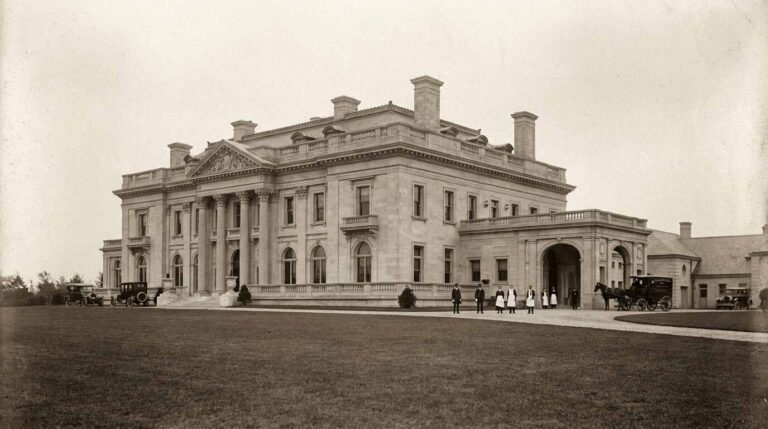
What Heckscher did in 1920 was consolidate an aesthetic field. The museum on Prime Avenue — designed by the firm Peabody, Wilson & Brown in the Beaux-Arts idiom that was already beginning to read as institutional gravitas rather than contemporary fashion — was not a neutral container for art. It was an argument about what art is, who it belongs to, and which community has the standing to adjudicate the question. I have shown enough houses in this town to know that the buildings people build to last are always arguments. The Heckscher Museum was a very large, very confident one.
The sociologist Pierre Bourdieu spent much of his career mapping what he called the field of cultural production — the social space in which aesthetic value is generated, contested, and distributed. His core insight, elaborated across The Field of Cultural Production (1993) and the earlier Distinction (1984), was that cultural legitimacy is never simply a property of the work itself. It is produced by the institutional infrastructure that surrounds the work: the museum, the critic, the collector, the deed of gift. When you donate a Beaux-Arts building to a municipality and fill it with European paintings and sculpture and invite the town in, you are not merely sharing your collection. You are installing the apparatus through which all future aesthetic claims in that community will be measured. This is what Heckscher did. Whether he knew the Bourdieusian vocabulary for it is beside the point.
What the Founding Collection Said
The Heckscher Museum opened with a collection that skewed heavily toward academic European painting and American art in the conservative tradition — the kind of work that, in 1920, signaled cultivation without provocation. This was deliberate. The deed of gift and early institutional documentation, held in the museum’s own archive, reflect a founding vision centered on education and civic uplift rather than avant-garde challenge. The museum was to be a place where Huntington’s residents could encounter what had already been decided to be art.
That is not a criticism. In 1920, this was a serious and sincere ambition. But it had a structural consequence that persists today: the Heckscher Museum established the terms under which aesthetic credibility on Long Island’s North Shore would be evaluated. Institutions that aligned with its sensibility — the associational galleries, the art societies, the school programs that fed into its collection — accumulated what Bourdieu would call symbolic capital. Practices that didn’t — the vernacular, the commercial, the experimental — were measured against a standard they hadn’t been consulted about setting.
The building itself participates in this argument. Peabody, Wilson & Brown’s design for the museum is a restrained Beaux-Arts structure whose primary rhetorical move is permanence. The symmetry, the stone, the classical references — these are the architectural vocabulary of institutions that intend to outlast the individuals who founded them. When you drive down Prime Avenue and see it now, the building still performs the same function it did in 1920: it tells you that what is inside has been sorted from what is outside, and that this sorting is legitimate.
The Gallery District as Counter-Field
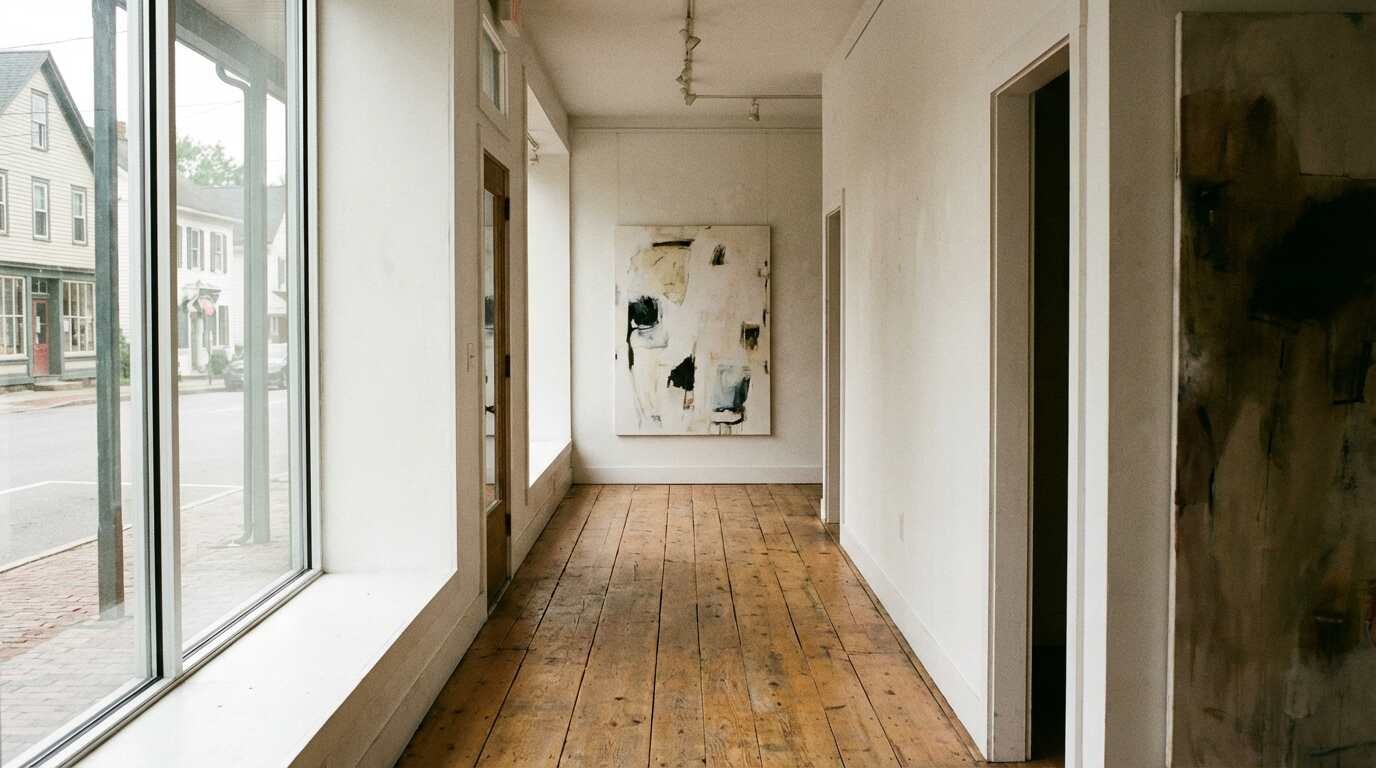
Huntington’s current gallery scene did not emerge in opposition to the Heckscher. That framing would be too neat. What emerged, particularly along the New York Avenue and Gerard Street corridor over the past decade, is something more ambivalent — a cluster of independent spaces, artist studios, and project rooms that operate within the cultural gravity of the museum without being able to claim its institutional weight.
I have walked that corridor a number of times, usually after showing property in the village, and what strikes me most is how clearly the two registers of cultural production occupy different spatial logic. The Heckscher sits on its lawn, monumental and singular. The gallery district is distributed, provisional, constituted by foot traffic and word-of-mouth and the particular energy of spaces that have not yet decided what they are. This is not a deficiency. It is the condition of a counter-field that has not yet accumulated enough symbolic capital to challenge the founding institution on its own terms.
Newsday’s coverage of the Huntington arts district over the 2015–2023 period documented the gradual consolidation of this corridor — new openings, closures, the arrival of programming connected to OHEKA Castle, which has its own complicated relationship to Gold Coast aesthetic authority. What that coverage rarely named was the structural dynamic underneath: that the question of which spaces count as part of the Huntington arts district, and which are peripheral to it, is still being resolved by reference to the field the Heckscher established in 1920.
This is worth understanding if you are thinking about the commercial real estate implications of the district’s development — and increasingly, the buyers I work with who are drawn to Huntington village ask about exactly this. A gallery corridor that achieves institutional recognition changes the character of its block. The mechanism is familiar: aesthetic legitimation drives foot traffic, foot traffic drives retail viability, retail viability drives residential desirability. The Heckscher’s invisible infrastructure, a century old, is still doing that work.
The OHEKA Complication
OHEKA Castle sits in Huntington and represents a different aesthetic lineage — not civic philanthropy in the Heckscher mold, but the Gold Coast’s private magnificence, the Gilded Age’s conviction that individual wealth was its own sufficient justification for grandeur. The programming OHEKA now hosts, and the cultural credibility it lends to events and exhibitions connected to its name, introduces a second pole in Huntington’s aesthetic field: the authority of the historically spectacular versus the authority of the institutionally legitimate.
Bourdieu would recognize this immediately as a field tension — two different modes of aesthetic capital competing for dominance within the same geographic and cultural space. Neither the Heckscher nor OHEKA has won this competition, because the competition is not the kind that gets won. It gets navigated, perpetually. The independent galleries along New York Avenue navigate it every time they write a press release, choose an opening, or decide which collector relationships to cultivate.
What I find interesting — and what I think is underreported in the existing coverage of Huntington’s cultural scene — is that the resolution of this tension will have spatial consequences. The direction in which aesthetic legitimacy flows will, over time, affect which blocks in the village consolidate as arts-district real estate and which remain transitional. This is not speculation. It is the pattern I have watched play out in every North Shore community where cultural investment precedes residential transformation.
Why It Matters Now
The Heckscher Museum’s centenary has passed. The gallery district it did not create but whose terms it set is old enough to have weathered economic contractions and is now, by most measures, a durable feature of Huntington village’s identity. The question is what comes next — whether the counter-field of the New York Avenue corridor will achieve enough institutional weight to redefine the center, or whether the Heckscher’s founding hierarchy will continue to determine what counts.
For anyone buying or investing in Huntington village, this is not an abstract question. The areas adjacent to confirmed arts-district activity — the blocks between the museum and the gallery corridor, the side streets off Gerard — are the ones worth watching. Not because galleries make neighborhoods, but because the process of aesthetic legitimation that the Heckscher initiated in 1920 is still unfolding, and its next chapter will be written in the buildings that get renovated, the storefronts that change use, and the streets that start to feel like somewhere rather than anywhere.
August Heckscher’s gift was not philanthropy in any straightforward sense. It was the founding act of a cultural field. A century later, Huntington is still living inside the argument he made.
For current listings and market data in Huntington and the surrounding North Shore, contact Pawli at Maison Pawli.
You Might Also Like
- The Walt Whitman Birthplace and the Dutch Saltbox Tradition — another Huntington landmark read through its architectural argument
- The Joiner’s Argument in Locust Valley — how Gold Coast aesthetic culture shaped the craftsmen who built for it
- The Landlord Nobody Remembers: How the Vanderbilt Estate Breakup Shaped Modern Centerport — another Gold Coast institution and its long afterlife in community identity
Sources
- Heckscher Museum of Art: https://www.heckscher.org/ — institutional history, collection documentation, founding archive references
- Pierre Bourdieu, The Field of Cultural Production (1993), Columbia University Press
- Pierre Bourdieu, Distinction: A Social Critique of the Judgement of Taste (1984), Harvard University Press
- Huntington Town Historian’s Office: https://www.huntingtonny.gov/content/9706/9761/default.aspx
- Newsday: https://www.newsday.com — Huntington arts district coverage, 2015–2023 (archive access required for specific articles)
- OHEKA Castle: https://www.oheka.com/