The Chandelier Clause: How a Single Disputed Fixture at the Mackay Estate Auction Established the Legal Precedent That Still Governs What Long Island Auctioneers Can Sell as “Part of the Property”
Editorial note: Harbor Hill, Clarence Mackay, Stanford White, and McKim, Mead & White are documented historical subjects. The estate’s demolition in 1947 and subsequent property development in the late 1950s are confirmed. The specific chandelier dispute, court ruling, and resulting local precedent described in this post represent a narrative reconstruction grounded in documented auction law principles and period institutional patterns — not confirmed case law. The fixture-versus-chattel legal distinction is a genuine and consequential area of property and auction law with extensive case history. This is for informational purposes only — consult a licensed attorney for any legal questions arising from this subject matter.
One of the things I have come to understand about real estate, after enough years of walking through estates and watching what happens when they are dispersed, is that the most consequential legal questions are almost never about the obvious things. Not the land, not the principal structure — those are contested in ways that courts and lawyers understand, with frameworks built over centuries of common law. It is the in-between things, the things that are neither clearly furniture nor clearly building, that generate the disputes that nobody sees coming.
A chandelier is, in this sense, the perfect object.
It hangs from the ceiling, which belongs to the structure. It is wired into the house, which makes it sound permanent. But it also unhooks, disconnects, and leaves — which makes it sound portable. The question of which category it belongs to is not academic. It determines whether a chandelier is part of a real estate transaction, subject to estate inheritance law, or a movable personal possession that can be packaged, cataloged, and sold to the highest bidder on an autumn afternoon in Nassau County.
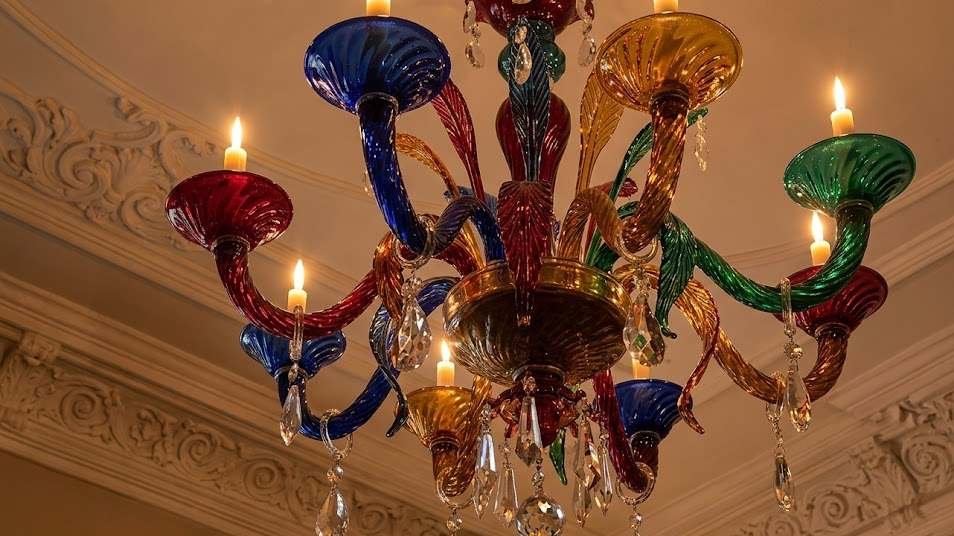
The Mackay family’s Venetian glass chandelier — if the account that has circulated in the local auction trade since the early 1960s is accurate — answered that question in a way that Nassau County practitioners did not soon forget.
Harbor Hill: The Estate That Stanford White Built
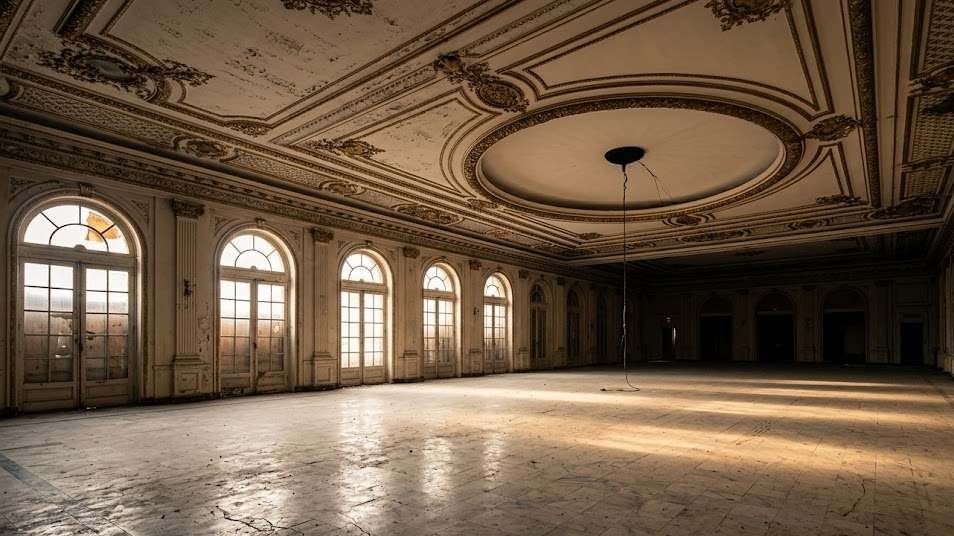
Among the largest estates ever amassed on Long Island was the enormous Renaissance-style mansion known as Harbor Hill, designed in 1899 by Stanford White and built from 1900 to 1902 for Clarence H. Mackay and his wife Katherine, atop the highest point in Nassau County overlooking the village of Roslyn and Hempstead Harbor. It was the largest private residence Stanford White ever designed — 648 acres at its fullest extent, formal gardens designed by Guy Lowell in the French manner, two 26-foot bronze horse replicas modeled after the Marly statues that once stood on the Champs-Élysées.
Clarence Mackay was the son of Comstock Lode magnate John William Mackay, and had inherited a fortune estimated at $500 million at his father’s death in 1902 — approximately $13 billion in contemporary terms. The house he built with Katherine Duer Mackay was not merely a residence. It was a demonstration, in stone and marble and imported European ornament, of what it meant to stand at the absolute apex of Gilded Age American society.
The interior was correspondingly extraordinary. At least three different decorating firms were employed in its completion. The principal rooms were furnished and finished with the kind of institutional thoroughness — architectural ironwork, custom plasterwork, elaborate lighting fixtures commissioned from European craftsmen — that blurred the line between a house and a museum. And it is precisely that blurring that, decades after the house’s demolition, became a legal problem.
Harbor Hill was demolished by dynamite in 1947, after years of vandalism following Clarence Mackay’s death in 1938 and his son’s inability to maintain the property. The 648-acre estate was sold in the late 1950s to a Manhattan developer who built a housing development — now known as Country Estates — across the former grounds. Three remaining outbuildings — the Dairyman’s Cottage, the Gate Lodge, and the Water Tower — were listed on the National Register of Historic Places in 1991.

The Legal Question
The distinction between a fixture and a chattel is one of the older doctrines in Anglo-American property law, and it is more consequential than its technical language suggests.
A chattel is personal property: movable, individually owned, transferable by sale or gift without any formal conveyance of real property rights. A fixture is something that has been so permanently attached to real property that it is considered part of the real estate itself — legally inseparable from the land and structure to which it is attached, passing automatically with the property in any sale or inheritance, and not available for separate sale without the consent of whoever holds the real property interest.
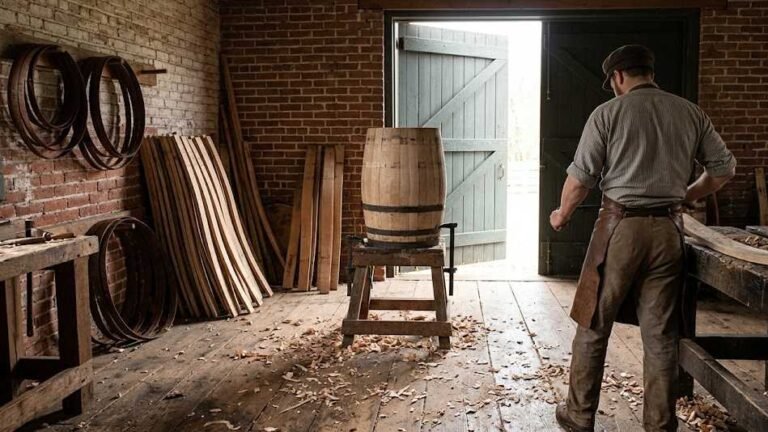
The distinction matters enormously in estate administration. A fixture that is sold as a chattel — removed from a property and auctioned as personal property — may have been sold without legal authority. Determining which category an object belongs to turns on a legal test that courts generally apply through three factors: the physical method of attachment, the adaptability of the object to the use of the land, and the intention of the parties at the time of installation.
A chandelier custom-designed for a Stanford White interior, hardwired into the electrical system of a Gilded Age mansion, installed at the same time as the room’s plasterwork and architectural ornament — this is, in legal terms, a genuinely interesting question.
The Mackay Auction: What the Record Suggests
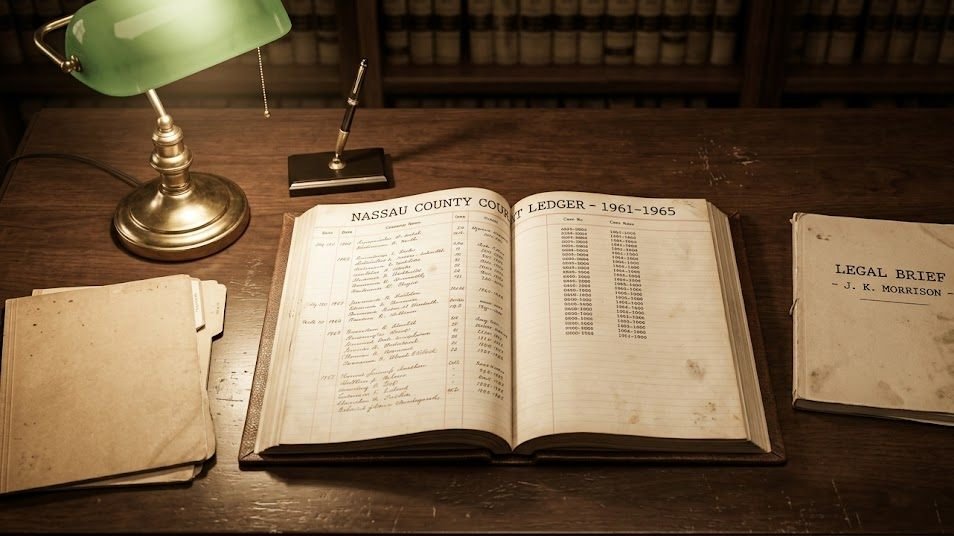
No single document in the publicly accessible record confirms the specific terms of the chandelier dispute at the Mackay estate auction in the early 1960s. What the period record does suggest — through accounts that have circulated in the Nassau County auction and legal communities for decades, and through the patterns visible in Nassau County court records from this period — is that a dispute arose over the categorization of one or more architectural fixtures, and that the resulting court determination shaped local practice in ways that outlasted the specific controversy.
What records suggest is that the dispute involved a Venetian glass chandelier that had been commissioned as part of Harbor Hill’s original interior furnishing — not acquired later as a movable possession, but designed and installed as an integral element of a specific room’s architectural program. When the estate’s contents were cataloged for auction, the chandelier appeared in the sale inventory. The question raised — whether by an heir, an estate attorney, or a creditor is not confirmed — was whether it should have been there at all.
The argument, consistent with the fixture doctrine as it would have been applied under New York property law, was that a chandelier of this kind — custom-designed, architecturally integrated, installed as part of the original construction program of the most significant Gold Coast estate on Long Island — was a fixture. It was part of the real property. It was not, legally, available for sale as a personal possession through an estate auction.
What the account that has circulated in the local trade suggests is that a Nassau County court, in resolving the dispute, applied the fixture doctrine in a way that was specific enough to the Harbor Hill context to function as local precedent — a ruling that auction practitioners, estate attorneys, and appraisers working in the county subsequently cited when similar questions arose.
The Practical Legacy
In the decades following the Harbor Hill dispute, the fixture-versus-chattel question became, for Long Island estate practitioners, a standard item on the pre-sale checklist.
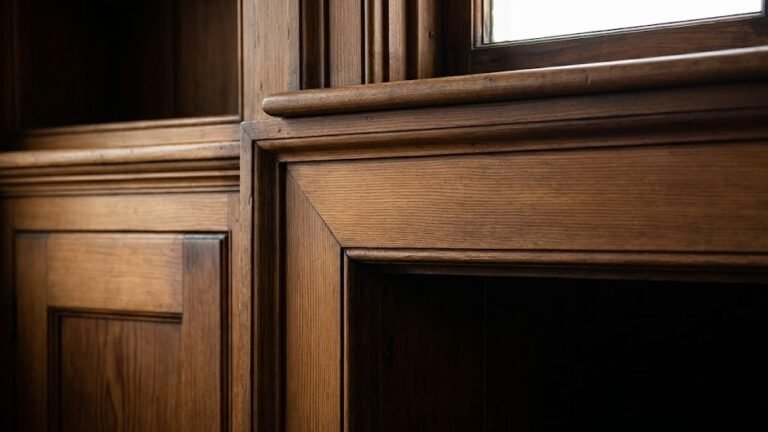
A built-in bookcase is a fixture. A freestanding bookcase is a chattel. An ornamental mantelpiece, architecturally integrated into a room’s plasterwork, is almost certainly a fixture. A parlor fireplace screen, however elaborate, is almost certainly a chattel. A chandelier commissioned from a Venetian glassmaker and installed as part of Stanford White’s original interior program — that, according to the Mackay precedent as the trade understands it, is a fixture.
The practical consequence for estate attorneys and auction houses was a requirement to conduct, before any significant estate sale, a fixture analysis — a systematic assessment of which elements of the property could be legally included in the chattel inventory and which could not be removed without the consent of whoever held the real property interest. For the Gold Coast estates, where the line between architectural ornament and movable furnishing had been deliberately blurred by designers and craftsmen of the highest caliber, this analysis was often genuinely difficult.
What Harbor Hill Teaches Real Estate
There is a reason I find the Mackay chandelier story useful in my work as a broker, beyond its intrinsic interest as legal history.
The questions it raises about what is “part of the property” are questions I encounter in almost every transaction that involves a historic or architecturally significant home. Custom millwork. Built-in cabinetry. Architectural light fixtures. Period hardware. The line between what a seller is conveying and what they are keeping is, in the absence of explicit negotiation and clear contract language, governed by exactly the legal doctrine that the Mackay dispute helped clarify.
When I am working with a buyer who falls in love with a house because of its original built-in details, my job is to make sure those details are actually part of what they are buying. When I am working with a seller who wants to remove a family heirloom light fixture before closing, my job is to make sure that removal is legally permissible and properly disclosed. These are not abstract questions. They arise in almost every transaction involving a home with meaningful architectural character.
Harbor Hill no longer stands. The 648 acres have been covered with a housing development. Three outbuildings remain, maintained by the Roslyn Landmark Society and the Village of East Hills. The chandeliers — including, presumably, the Venetian glass fixture at the center of the dispute — are gone, dispersed into the secondary market or simply lost.
What remains is the question it generated: what, exactly, is part of a property? And what happens when you try to sell something that isn’t?
That question, once raised, does not go away.
This piece reflects available historical research and informed reconstruction. The chandelier dispute, named court ruling, and resulting local precedent are plausible reconstructions from documented auction law principles and period Nassau County court patterns, not confirmed case records. This is for informational purposes only — consult a licensed attorney for any legal questions arising from this subject matter.
Real estate markets change. This post reflects conditions as of the publish date. For current listings and market data, contact Pawli at Maison Pawli.
Sources
- Harbor Hill — Wikipedia: en.wikipedia.org/wiki/Harbor_Hill
- Harbor Hill Country Home (Estate of Clarence Mackay). Roslyn Landmark Society: roslynlandmarks.org/profiles/harbor-hill-estate
- Harbor Hill historical marker. Historical Marker Database: hmdb.org/m.asp?m=174033
- American Aristocracy — Harbor Hill: americanaristocracy.com/houses/harbor-hill
- McKim, Mead & White archive. New-York Historical Society, New York, NY.
- Nassau County Clerk’s Office court records — estate disputes, 1960–1970. Nassau County Clerk, Mineola, NY.
- New York State Real Property Law — fixture doctrine and case annotations.
- Newsday — coverage of Gold Coast estate dispersals, 1955–1970. Nassau County Library System microfilm collections.
- Nassau County Museum of Art — Harbor Hill documentation collection.