Why Your 1960s Ranch Renovation Is Fighting the Soil — The Glacial Till Problem Hiding Under North Shore Slabs
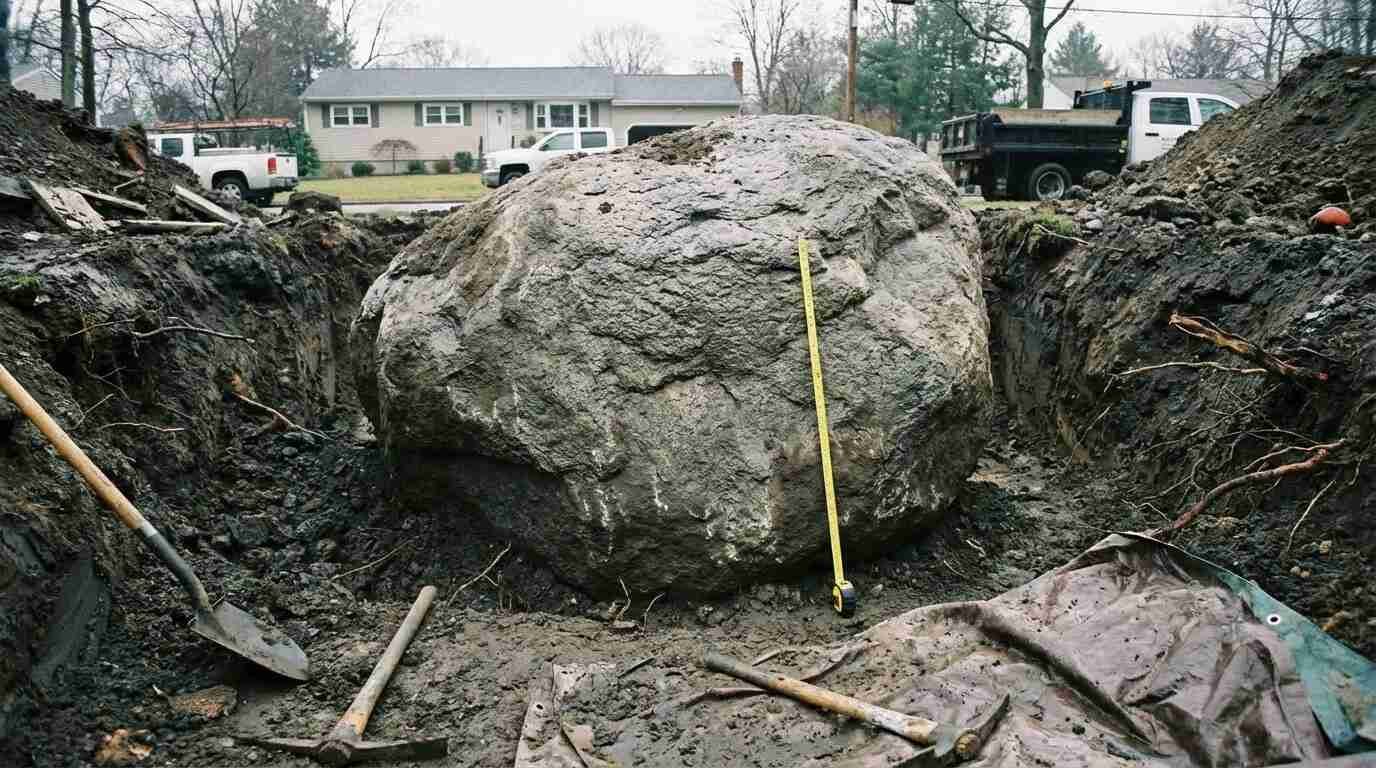
The Wisconsin Glacier retreated across Long Island roughly 20,000 years ago, and it left behind something that no zoning map, no MLS listing, and no home inspection report will tell you about: a chaotic, unpredictable substrate of boulders, dense clay, and gravel that still dictates — and sometimes destroys — every renovation budget on the North Shore. I’ve watched buyers fall in love with 1960s ranches in Kings Park, in Commack, in Smithtown and Saint James, and I’ve watched those same buyers discover, six weeks into a basement expansion or a foundation repair, that the soil beneath their slab is doing something entirely different from what they expected.
This is not a niche problem. It is the defining renovation variable on the North Shore, and it is almost never discussed before the contract is signed.
Two Islands, Two Completely Different Soils
Long Island is, geologically speaking, two islands in one — or more precisely, two different glacial events laid down on top of each other, separated by time and by what the ice was carrying when it stopped.
The South Shore sits primarily on glacial outwash plain: sandy, permeable, relatively uniform material deposited by meltwater streams that ran off the retreating glacier’s southern margin. South Shore soil drains fast. It shifts under load in predictable ways. Contractors who work below ground on the South Shore have a reliable material science to work with.
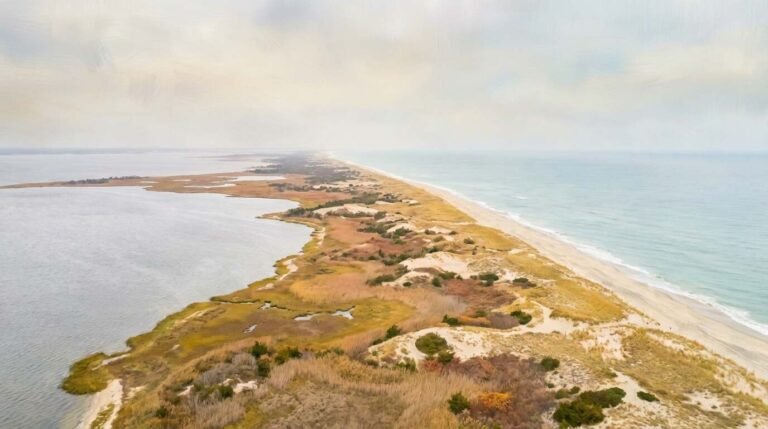
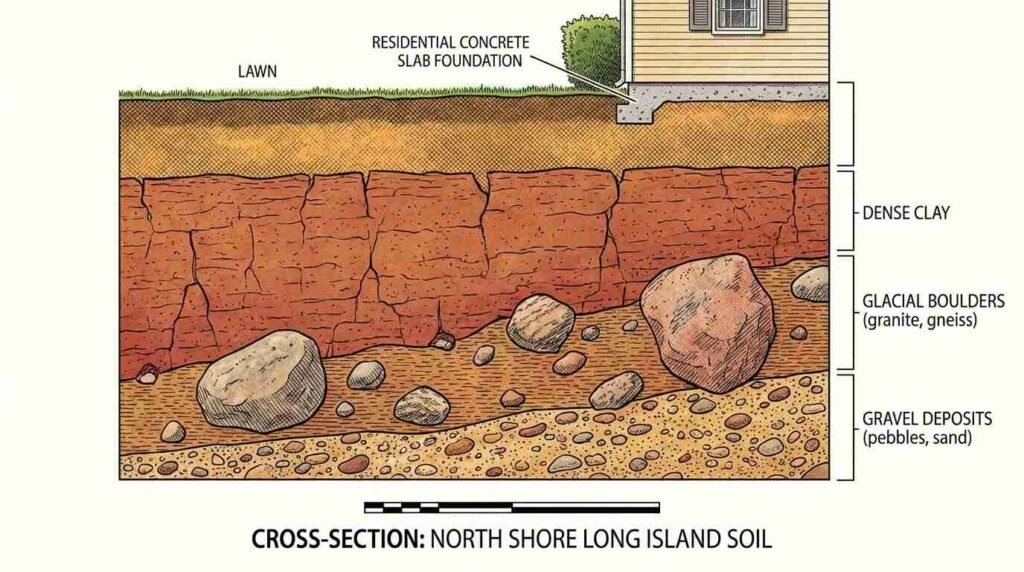
The North Shore is built on the moraines themselves — the piled deposits of till that mark where the glacier actually sat during its two major pauses in the Pleistocene. The Harbor Hill Terminal Moraine, which runs through Cold Spring Harbor, Huntington, and Smithtown, is composed of what the USGS describes as “unsorted and unstratified clay, silt, sand, gravel, cobbles, and boulders” — the full chaotic inventory of everything the ice picked up as it pushed south from New England. The glacier did not sort this material. It dumped it. The result, 20,000 years later, is a substrate that can change composition dramatically within a single parcel.
Foundation contractors who work the North Shore full-time know this. The South Shore crews they occasionally pull in for big jobs often don’t, and that mismatch is where renovation budgets go sideways.
What the Clay Does to Your Foundation
The North Shore soil composition is “basically clay,” as one Long Island foundation repair firm puts it — and clay soil behaves fundamentally differently from the sandy substrate homeowners assume they have. Clay holds water. It expands when wet and contracts as it dries. In a climate with Long Island’s freeze-thaw cycling — alternating periods of saturation, freezing, thaw, and summer drought — clay soil subjects foundation concrete to a continuous compression-and-release cycle that sand-based soil never produces.
The concrete expands and contracts with temperature. The clay expands and contracts with moisture. When these two cycles go slightly out of phase, as they inevitably do, the result is differential settlement: one corner of a slab sinks faster than another, doors start sticking, windows go out of plumb, and a hairline crack in the foundation wall that appeared in spring becomes a quarter-inch gap by November.
On the North Shore, this process is accelerated by a second variable: perched water tables. Because the moraine material is so irregular — layers of impermeable clay sitting above or beside layers of permeable gravel — groundwater frequently gets trapped in pockets rather than draining cleanly through the soil. The result is seasonal flooding in basements that were dry for decades, appearing seemingly without cause, because a new grading pattern in an adjacent yard, or a change in a neighbor’s drainage, has redirected subsurface water into a previously isolated clay pocket beneath your slab.
I’ve seen this catch buyers completely off guard. A North Shore ranch that passed its home inspection with no moisture indicators in the basement can develop standing water two winters later because of a drainage adjustment three houses away. The clay-and-boulder substrate doesn’t telegraph these vulnerabilities in advance. It waits.
The Boulder Mid-Excavation Problem
The clay is the slow problem. Boulders are the expensive surprise.
The Harbor Hill and Ronkonkoma moraines are full of glacial erratics — boulders carried down from New England and Canada by the advancing ice and dropped wherever the ice happened to melt. On the North Shore’s beach bluffs, these boulders are visible: the rocky shores that distinguish North Shore beaches from South Shore sand are composed primarily of glacial erratics that fell to the beach as the bluffs eroded above them.
Beneath North Shore properties, the same boulders exist, buried at depths that range from two feet to fifteen feet, with no predictable pattern and no surface indication of their presence. Soil surveys and soil borings can locate them within a specific bore hole, but a boulder eight feet to the left of the bore hole will not appear in the survey. For any excavation work — basement expansions, new foundation footings, in-ground pools, underground utility runs — the boulder problem is the contingency that no contractor can price with certainty.
The standard industry practice among North Shore contractors who have been burned by this is to build a boulder contingency into every excavation quote. The contingency varies — $5,000 to $20,000 is typical for a basement expansion; more for larger excavation projects — and experienced local contractors will explain it upfront. Contractors who haven’t done much North Shore work won’t mention it because they don’t know to mention it, and the resulting cost-plus change order mid-project is invariably a source of significant friction.
If you’re buying a 1960s ranch anywhere along the Harbor Hill moraine — which runs through Cold Spring Harbor, Huntington, Smithtown, and their surrounding communities — and you intend to do any below-grade work, add a boulder contingency to your renovation budget before you make an offer. The question is not whether you will encounter one. The question is how large it will be and how deep.
What the 1960s Ranch Compounded
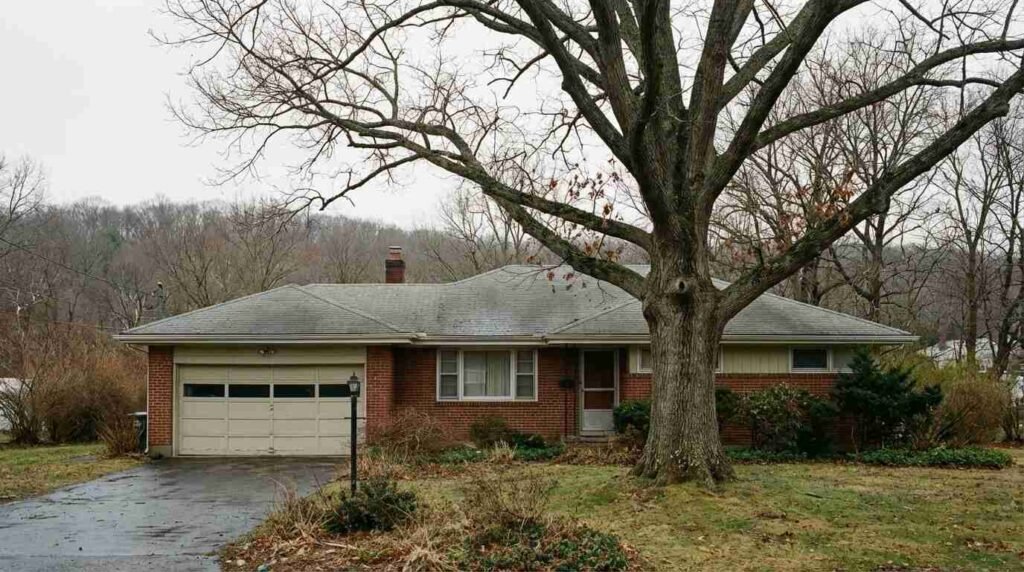
The mid-century ranch was built for a specific postwar logic: rapid construction, minimal site preparation, maximum livable floor area per lot. The house went up fast, often on a shallow poured-concrete slab that transferred the full weight of the structure directly to whatever soil happened to be at grade level. No engineer was walking the parcel looking for clay pockets. No soil boring was specified. The house went up in weeks, and in the postwar suburban boom, most of them held together perfectly well for decades because the initial site preparation happened to avoid the worst of the moraine’s subsurface chaos.
Sixty years later, the ranches that got unlucky are showing it. I’ve written before about the hidden renovation budget line that Suffolk County fixer-uppers are sitting on, and the glacial till problem is structurally similar in that it’s a known variable that almost never surfaces during a buyer’s due diligence process. The home inspector doesn’t dig. The listing doesn’t mention it. The seller may genuinely not know — the clay-related differential settlement can be slow enough that it reads as normal aging.
What to look for in a showing: sticking doors on the interior, particularly doors that stick at the top corner diagonally opposite from the hinges. Windows that no longer open smoothly. Diagonal cracks in drywall running from the corners of door frames toward the ceiling. A basement floor that has a visible tilt when you hold a level to it. A north-facing foundation wall that shows efflorescence — the white salt deposits that appear when water has been migrating through concrete repeatedly. None of these is definitive on its own. In combination, they warrant a structural engineer’s assessment before you commit.
Smithtown to Cold Spring Harbor: The Moraine’s Real Estate Implications
The Harbor Hill moraine’s path through the North Shore isn’t just a geological fact — it maps almost exactly onto the communities that have the highest concentration of mid-century ranches with the most complex renovation histories.
Smithtown sits directly on the moraine, its rolling topography a direct product of glacial deposition. Kings Park and Commack are both moraine communities. St. James and Nissequogue. East Northport and Centerport. Cold Spring Harbor, where the moraine bends slightly south before continuing east, has some of the highest-density boulder deposits on the western North Shore — a product of the particular load the glacier was carrying as it stopped in that section.
The real estate implications run in two directions. On one hand, the moraine’s rolling terrain is precisely what gives North Shore communities their distinctive character — the hills, the kettle lakes, the natural drainage that carves the coves. No moraine, no North Shore as we know it. On the other hand, buying below-grade in moraine territory is a different proposition from buying below-grade anywhere else on Long Island, and the price you pay for a ranch with “good bones” should reflect the cost of doing the below-grade work properly.
The USDA Web Soil Survey allows parcel-level soil identification across Suffolk County, and Cornell Cooperative Extension Suffolk County has published soil series documentation that a contractor or engineer can use to characterize a specific site’s likelihood of clay-heavy or boulder-dense conditions. Running this check before finalizing a purchase decision on any North Shore property where significant excavation is planned is not paranoid due diligence. It is how you avoid a $40,000 mid-project surprise.
What Smart Buyers Do Differently
The North Shore renovation buyers who don’t get caught by the glacier are the ones who build soil uncertainty into their acquisition math from the beginning rather than treating it as a risk they’ll deal with later.
In practice, this means three things.
First, commission a soil boring — even a single boring at the planned excavation point — before closing on any property where below-grade work is planned. A boring will identify clay depth, boulder likelihood at that specific location, and groundwater level. The cost is in the hundreds of dollars. The information is worth multiples of that.
Second, get excavation bids from contractors who have specifically worked in your target community. A contractor who has done basement work in Smithtown for twenty years has hit enough boulders to know roughly what the contingency should be. A contractor coming from Nassau County’s South Shore hasn’t.
Third, when you get those bids, ask specifically: what is your boulder contingency policy? Is it included in the fixed price or billed as a change order? A reputable North Shore contractor will answer this without hesitation. One who doesn’t know what you’re asking is telling you something important.
The ranch renovations that go well on the North Shore go well because someone asked these questions early. The ones that go badly are the ones where the glacier got to have its say in the middle of a project, on the clock, at $400 an hour for a hydraulic excavator that has just hit its third boulder in two days and isn’t done yet.
The ice is long gone. But it left its work here, and if you’re buying on the North Shore, you’re working around it.
You Might Also Like
- The Asbestos Ceiling Nobody’s Talking About: Why Suffolk County Fixer-Uppers Are Sitting on a Hidden Renovation Budget Line
- Before the Bulldozer: How a Forgotten Depression-Era Government Program Pre-Framed Thousands of Long Island Homes Still Standing Today
- The Contractor Shortage Nobody Warned You About: Why Long Island Permits Are Taking 14 Months and What Savvy Renovators Are Doing Differently
Real estate markets change. For current listings and market data, contact Pawli at Maison Pawli.
Sources
- USGS — Surficial and Northern Atlantic Coastal Plain Aquifer Systems, Long Island
- Garvies Point Museum — Geology of Long Island
- High Rise Industries Inc. — Foundation Repair Long Island
- USDA Web Soil Survey
- ArcGIS StoryMaps — Long Island’s Dynamic History
- New York State Geological Association — Geology, Geomorphology, and Late-Glacial Environments of Western Long Island