The Deed Before the Vineyard: Tracing the Agricultural Lineage of North Fork’s Most Celebrated Wine Estates
There’s a photograph I keep thinking about. It’s from the early 1970s — a couple in work clothes standing in a flat field in Cutchogue, the soil turned over, the light flat and winter-gray. Alex and Louisa Hargrave, they were twenty-something, and what they were looking at wasn’t a vineyard. It was a run-down potato farm they’d just bought with borrowed money, on a stretch of the North Fork that people still described as farmland, because that’s what it was.
What they planted there in 1973 — ten thousand vinifera vines, by hand — didn’t just launch an industry. It initiated the most consequential agricultural land transfer story in modern Suffolk County history. Because before Bedell Cellars crushed its first vintage, that land was a potato farm. Before Paumanok planted its first Riesling, somebody else held title. And the deed to every major North Fork wine estate still carries, embedded in its legal description and chain of ownership, a century of agricultural history that most buyers never bother to read.
I’ve spent more than a decade as a licensed broker on Long Island, and the one thing I’ve learned about the North Fork is that the land doesn’t change allegiances quickly. It just changes crops.
What the Hargraves Actually Bought
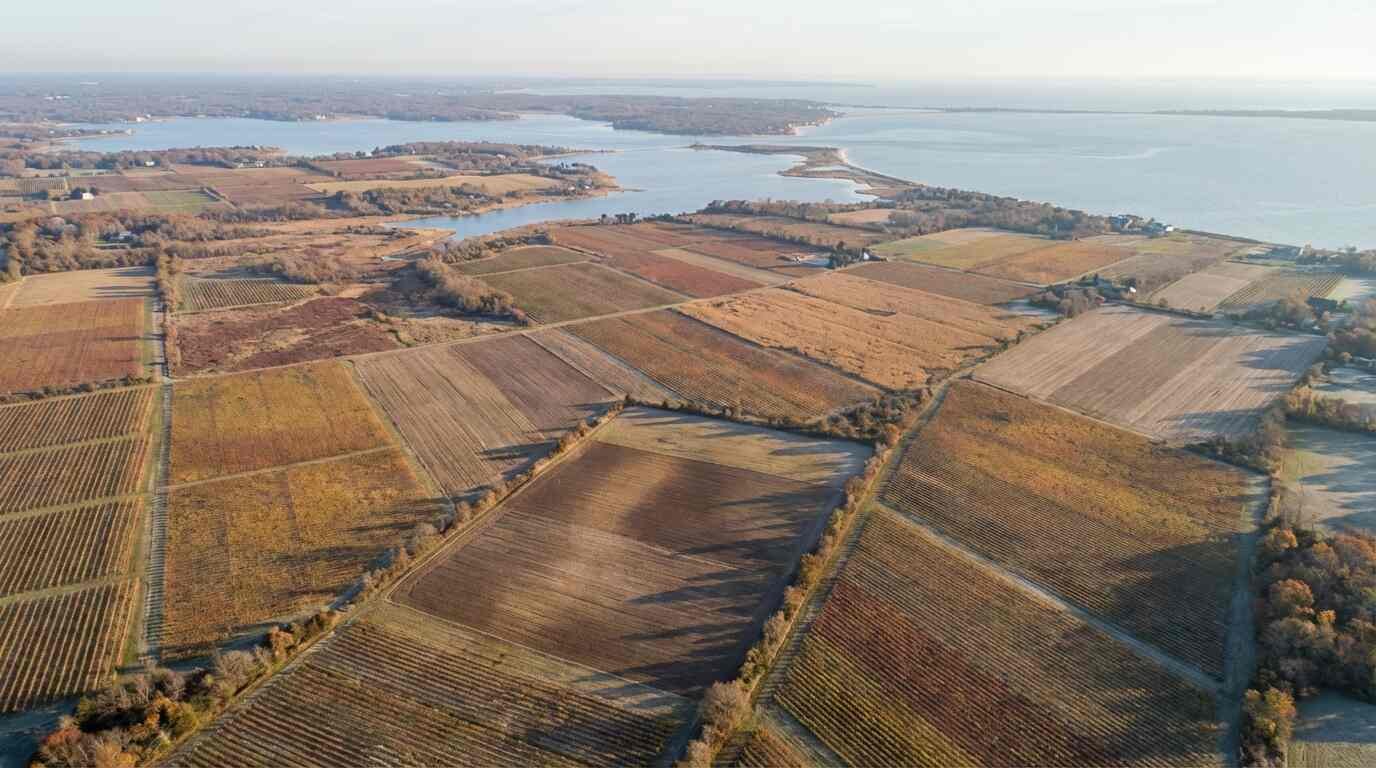
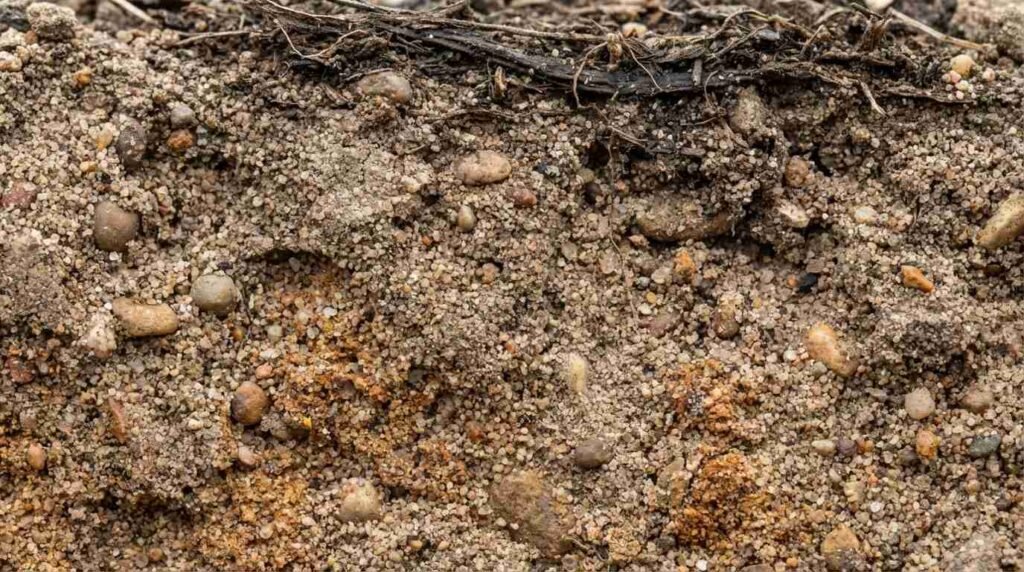
The soil science is where this story starts. The North Fork sits atop a glacial outwash plain laid down thousands of years ago when two great moraines — the Ronkonkoma to the south, the Roanoke Point to the north — formed the structural spine of Long Island’s East End. What the retreating glacier left behind was a deep, well-drained profile of sandy loam, gravelly subsoil, and almost no clay. The U.S. Soils Conservation Service rates these soils “1-1” — the most auspicious agricultural classification there is.
That soil made the North Fork one of the great potato-producing regions in the Eastern United States. Suffolk County’s sandy loam drains quickly after rain, warms fast in spring, and doesn’t compact under heavy equipment. For decades, the North Fork ran on potatoes. The same drainage characteristics that kept potato roots from rotting in wet conditions, the same soil texture that kept tubers clean and uniform, are the precise qualities that now attract viticulturists. Vine roots don’t want wet feet. They want to reach, to stress slightly, to pull minerals from depth. The North Fork glacial outwash gives them exactly that.
When the Hargraves purchased their Cutchogue farm in 1973, they weren’t buying an inert piece of land. They were acquiring a soil profile — one the previous owners had been farming for decades. The property’s deed chain through the Suffolk County Clerk’s office would show what every North Fork agricultural parcel of that era shows: transfers through families who’d been working the land since at least the postwar boom, back through Depression-era farm consolidations, back into the 19th century when the hamlets of Cutchogue, Mattituck, Southold, and Peconic were organized not around tourism or wine trails but around the annual rhythm of planting, harvesting, and getting product to the LIRR depot in time for the New York City markets.
Three Estates, Three Deed Histories
Kip and Susan Bedell planted their first vines in 1980 on land in Cutchogue that, like most of the surrounding parcels, had spent its recent history as working agricultural ground. What the Bedells understood — and what their winemaker Richard Olsen-Harbich spent the next four decades proving — was that the maritime terroir of the North Fork was not merely adequate for serious viticulture but potentially exceptional. Olsen-Harbich wrote the North Fork AVA into legal existence in 1986, an act that formally encoded the region’s agricultural identity as a wine-producing area for the first time. Before that, the Suffolk County deed record simply described these parcels as farmland — no different from the potato operations that had preceded them.
The Bedells sold to Michael Lynne in 2000, and the title transferred again, but the vines — some of the oldest in the region — stayed in the ground. That continuity of planting is itself a form of deed history. The roots of Bedell’s oldest Merlot blocks have been in the same Cutchogue soil since 1980. The land changed hands; the agriculture didn’t.
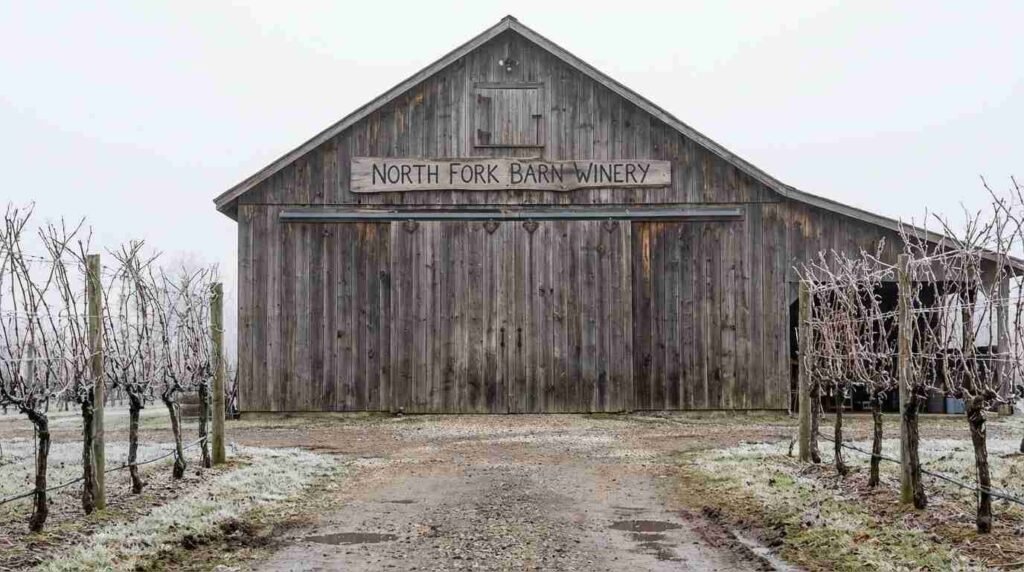
Lenz was established in 1978 — actually predating Bedell — by Peter and Patricia Lenz, who were inspired by the Hargraves’ early experiments. The winery’s tasting room sits in what was originally a potato barn, which is not incidental. It is a material record of the land’s prior use. When Peter and Deborah Carroll purchased Lenz in 1988, back when there were fewer than ten established wineries on the entire North Fork, they weren’t just buying a winery. They were buying a property whose agricultural function had shifted, but whose building stock still announced its farming origins to anyone paying attention.
The potato barn tasting room is the kind of structural evidence that a property historian reads the way a geologist reads strata. It tells you what came before. It tells you how the land was worked before anyone thought to plant Gewürztraminer in it.
The Massoud story is perhaps the most instructive. In 1983, Charles and Ursula Massoud — he a former IBM executive, she from a winemaking family in the Pfalz region of Germany — bought a potato farm in Aquebogue and closed on the property with the intention of planting grapes. They spent their first six or seven years as grape growers only. The winery followed in 1990, built into a renovated turn-of-the-century potato barn. Their first bottled wine didn’t reach consumers until 1991.
That eight-year span between land acquisition and first vintage is significant. The Massouds weren’t buying into an established wine business. They were converting agricultural property — deed, soil, outbuildings and all — from one crop to another. The Suffolk County Clerk’s plat books would show their parcel as it had been recorded for generations: farmland in the Town of Riverhead, bounded by the same property lines that previous owners had farmed under entirely different economic assumptions.
What the Deed Actually Tells a Buyer
If you’re looking at a North Fork property today — agricultural, residential, or mixed — and the parcel abuts or overlaps what was historically farmed ground, the deed chain is worth pulling. Not because it changes what the land is worth, but because it tells you what the land is.
The North Fork AVA, formally established in 1986 and covering roughly 65,000 acres between the Peconic River and Orient Point, is built almost entirely on converted farmland. The same soil survey that made Southold and Riverhead townships attractive to potato growers in the early 20th century is the one that made them attractive to viticulturists in the 1970s and ’80s. The deed history of any parcel in that corridor is not just a legal record — it’s a soil biography.
For buyers looking at agricultural parcels, converted barns, or properties that sit within or adjacent to the wine country corridor, I always recommend pulling the original plat records from the Suffolk County Clerk’s historical files before the current survey. The lot dimensions, road alignments, and easements recorded when these parcels were first subdivided can still govern what you can and can’t do with the land today. The same goes for agricultural use restrictions and farmland preservation easements, which have been applied broadly across the North Fork since the 1970s as a condition of keeping the landscape from being subdivided into residential lots.
The North Fork’s wine country is a land-use story as much as it’s a viticulture story. The grapes came second. The deeds came first.
For buyers researching the Eelgrass Crisis in Peconic Bay and what it means for waterfront parcels in the same corridor, my earlier post covers the water quality data that every bayfront buyer in Southold and Shelter Island should read before closing. And if the question of what a deed actually contains — including restrictive covenants that run with the land — is something you’re navigating as a first-time buyer, the post on restrictive covenants and their lasting effects on Long Island property is worth your time before you sign anything.
- The Eelgrass Crisis in Peconic Bay — What Bayfront Buyers in Southold and Shelter Island Need to Know
- The Covenant in the Deed: How Restrictive Covenants Shaped Long Island Neighborhoods
- Why Sag Harbor’s Whaling Decline Created the Exact Lot Sizes That Make It the Most Walkable Village on the East End Today
Real estate markets change. For current listings and market data, contact Pawli at Maison Pawli.
This is for informational purposes only — consult a licensed attorney or financial advisor for your specific situation.
- Bedell Cellars, Heritage Page: https://www.bedellcellars.com/heritage
- Northforker Archives, “Winery Spotlight: Bedell Cellars” (2020): https://archive.northforker.com/2020/05/winery-spotlight-bedell-cellars/
- North Fork Authentic, Lenz Winery: https://www.northforkauthentic.com/marketplace/lenz-winery
- Lenz Winery, About Us: https://www.lenzwine.com/about-us
- Dan’s Papers, “Sister Vineyards Paumanok & Palmer: 40 Years on North Fork” (2023): https://www.danspapers.com/2023/06/vineyards-paumanok-palmer-40-years/
- Grape Collective, Kareem Massoud interview: https://grapecollective.com/articles/kareem-massoud-paumanok-vineyards-in-long-island
- Suffolk Times, “Guest column: Fifty years making beautiful wine in a beautiful place” (2023): https://suffolktimes.timesreview.com/2023/05/guest-column-fifty-years-making-beautiful-wine-in-a-beauty-place/
- Long Island Sustainable Winegrowing, Soil Overview: https://www.lisustainablewine.org/our-soil
- Cutchogue–New Suffolk Historical Council, First Winery on the North Fork: https://www.cutchoguenewsuffolkhistory.org/timeline/first-winery-on-the-north-fork-1972/
- North Fork of Long Island AVA established 1986: https://newyork.guides.winefolly.com/regions/north-fork-of-long-island/